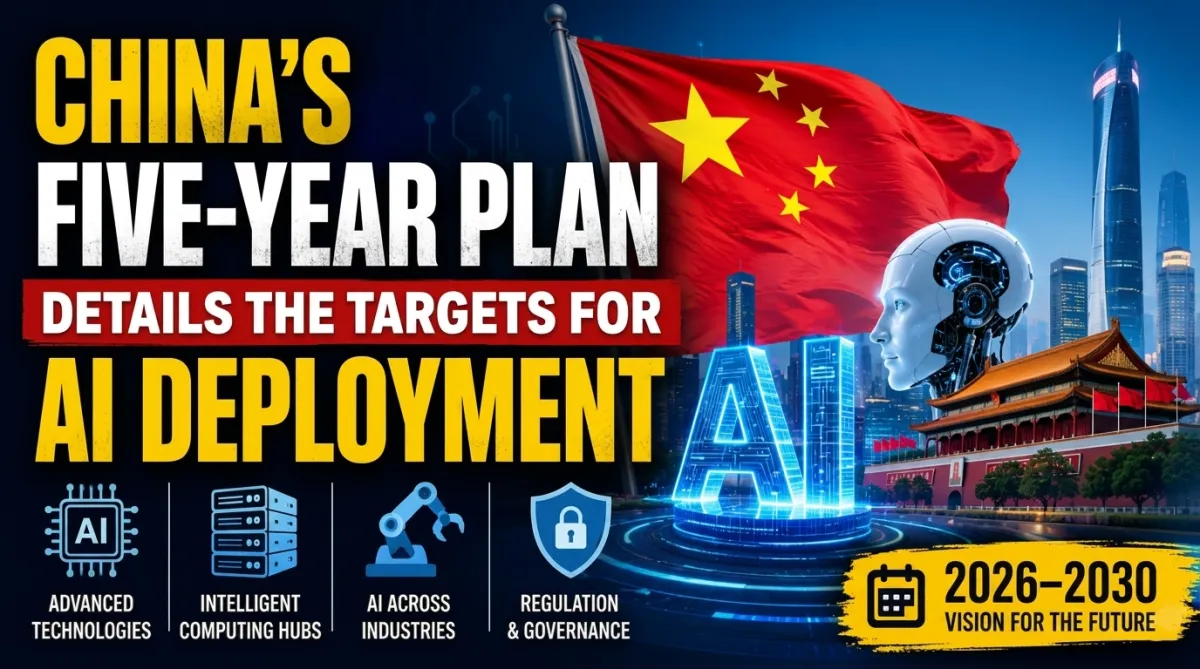
China has laid out an ambitious roadmap for the next phase of its technological growth through the approval of its 15th Five-Year Plan, a long-term national strategy that outlines the country’s priorities until 2030. Among the major focus areas, artificial intelligence stands out as a key driver for future economic development, industrial transformation, and digital modernization.
The new plan makes it clear that AI is no longer being treated as a standalone technology. Instead, it is being integrated into broader national goals covering infrastructure, manufacturing, education, healthcare, and public administration.
AI Positioned Alongside Critical Future Technologies

In the latest policy framework, artificial intelligence is grouped with advanced sectors such as quantum computing, biotechnology, and energy innovation. China sees these industries as essential for maintaining technological competitiveness and strengthening long-term economic growth.
The government intends to invest further in high-performance AI chips and the software ecosystems required to support them. Research institutions and private companies are also expected to continue working on next-generation AI architectures, core algorithms, and model efficiency improvements.
This approach reflects China’s larger effort to build greater self-reliance in advanced technologies while reducing dependence on foreign hardware and software platforms.
Advanced Networks to Power AI Infrastructure
The strategy also places significant emphasis on communications infrastructure. China plans to continue expanding technologies such as satellite communications, enhanced 5G networks, and future 6G systems.
These upgrades are expected to support the growing demand for data processing and AI-driven applications across industries. Faster networks and stronger digital infrastructure will help improve large-scale computing, real-time data transmission, and intelligent automation systems.
The government views connectivity as a foundation for AI adoption, especially in sectors that require constant data exchange and high computing performance.
National Computing Hubs to Increase AI Access
One of the most notable aspects of the plan is the proposal to develop large national computing centers described as “intelligent computing clusters.” These facilities are designed to provide businesses, researchers, and institutions with better access to advanced computing resources.
China also wants to introduce market-based systems that would allow companies to lease computing power instead of building expensive infrastructure independently. This could make AI development more accessible for smaller firms and startups that may otherwise struggle to compete with larger technology companies.
The policy additionally mentions improving the way public institutions purchase and use computing services, suggesting that cloud-based and shared AI resources may become more common across government operations.
AI Adoption Expected Across Major Industries
The Five-Year Plan highlights several sectors where AI integration is expected to increase rapidly over the coming years.
Manufacturing remains a major priority, with AI expected to improve industrial design, production efficiency, automation, and operational management. Energy systems and agricultural production are also identified as important areas where intelligent technologies can improve productivity and resource management.
In the services sector, China sees growing opportunities for AI in logistics, financial services, and software-related industries. Businesses operating in these fields may increasingly rely on automation, predictive systems, and data-driven decision-making tools.
The broader objective appears to be creating a more digitally connected economy where AI supports both industrial modernization and everyday commercial activity.
Consumer Technology and Public Services
Beyond industrial applications, the Chinese government also wants AI to become more deeply integrated into consumer technology and public services.
The plan encourages wider adoption of AI-powered devices such as smartphones, computers, and robotics systems. It also outlines several public-facing use cases for artificial intelligence, particularly in education, healthcare, elderly care, and social welfare services.
In education, AI-based adaptive learning systems could help personalize teaching methods for students. Healthcare systems may use AI tools for diagnostic assistance and medical data analysis, while welfare programs could rely on digital systems to improve administrative efficiency.
These initiatives suggest that AI is expected to play a larger role not only in economic growth but also in day-to-day public service delivery.
Digital Governance and Public Administration
China’s strategy also includes plans to expand digital governance through integrated data systems and AI-supported administration.
The government wants public sector services at both national and local levels to become more connected and data-driven. Standardized digital systems are expected to improve coordination between departments while enabling faster decision-making processes.
AI models may also be used in areas related to public safety risk assessment and administrative management. However, the plan does not provide extensive details about how these systems will be implemented in practice.
Stronger Focus on Regulation and Data Security
Alongside expansion efforts, the Five-Year Plan gives considerable attention to AI regulation and data governance.
The document calls for clearer legal and regulatory frameworks covering algorithm registration, transparency standards, and security requirements. Authorities also acknowledge concerns related to deepfakes, misuse of data, and broader risks that AI technologies may create for the economy and society.
This balanced approach shows that China is attempting to accelerate AI adoption while also maintaining tighter oversight of how these systems are developed and deployed.
A Different AI Strategy From Western Markets
China’s long-term AI direction continues to differ from the approach commonly seen in many Western countries. Rather than focusing entirely on massive proprietary models controlled by a few dominant firms, China has increasingly supported smaller, efficient, and more openly available AI systems.
This strategy could allow broader participation across industries while lowering infrastructure costs for developers and businesses.
Over the next five years, global observers will likely watch closely to see whether China continues along this path or adjusts its strategy in response to international competition and evolving technological trends.
Looking Ahead
The newly approved Five-Year Plan demonstrates that artificial intelligence will remain central to China’s future development strategy. From industrial automation and digital infrastructure to healthcare and education, AI is expected to influence nearly every major sector of the country’s economy.
While many implementation details are still likely to emerge gradually, the direction is already clear: China intends to deepen AI integration across both public and private sectors while building the infrastructure needed to support long-term technological growth.